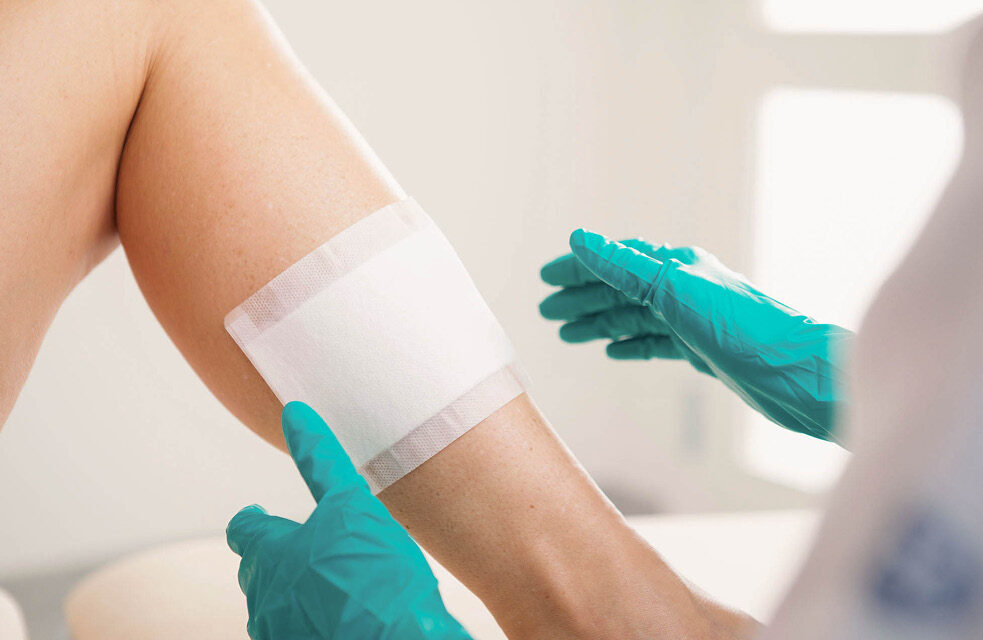
Absorbest BioShield is an innovative superabsorbent dressing for exuding wounds. It helps prevent biofilm formation on the dressing and in the immediate surrounding area.¹ Its mode of action is non-antimicrobial, meaning it does not kill bacteria.
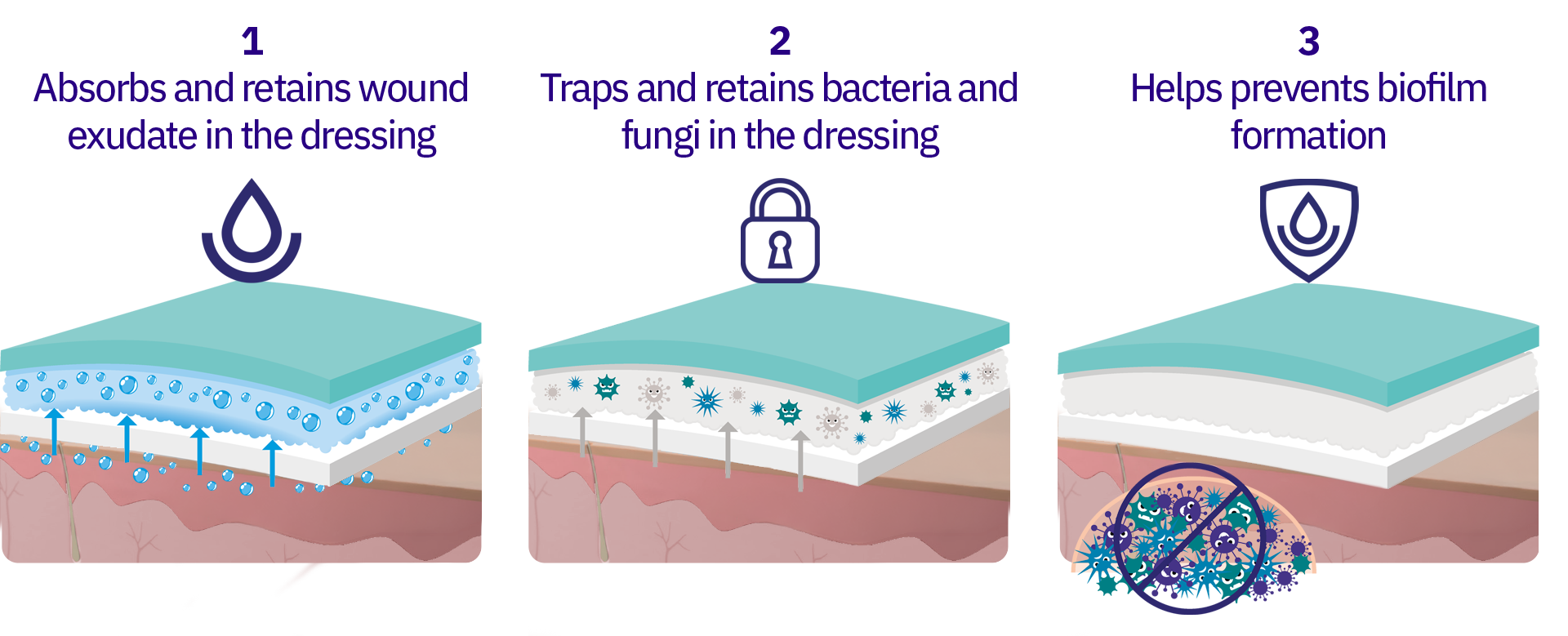
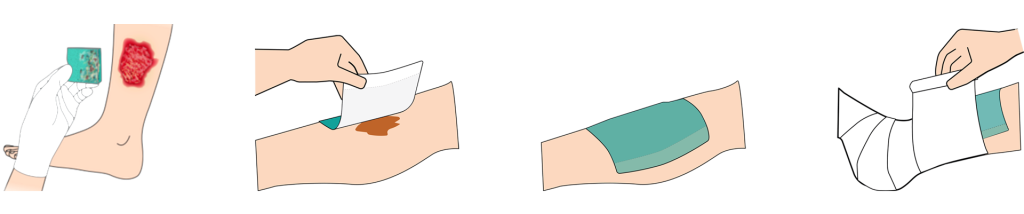
1. Absorbs and retains wound exudate in the dressing
2. Traps bacteria in the wound exudate and retains them within the dressing
3. The contact surface makes it more difficult for microorganisms to attach and form biofilm

Absorbs and retains wound exudate within the dressing

Traps and retains bacteria within the dressing

Helps prevent biofilm formation
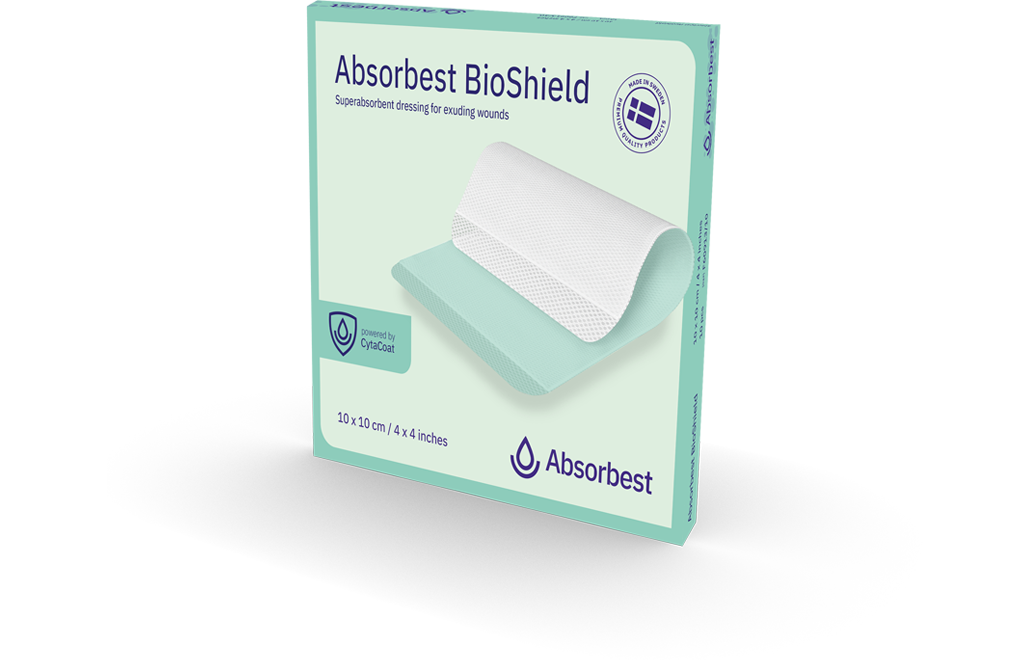
Absorbest BioShield is a sterile, conformable superabsorbent dressing for exuding wounds. Absorbest BioShield absorbs and retains exudate in the dressing. The exudate is absorbed vertically by the dressing and is retained in the core forming a gel, thus minimizing the risk of maceration and maintaining a a moist wound environment. The dressing remains dry and comfortable for the patient.
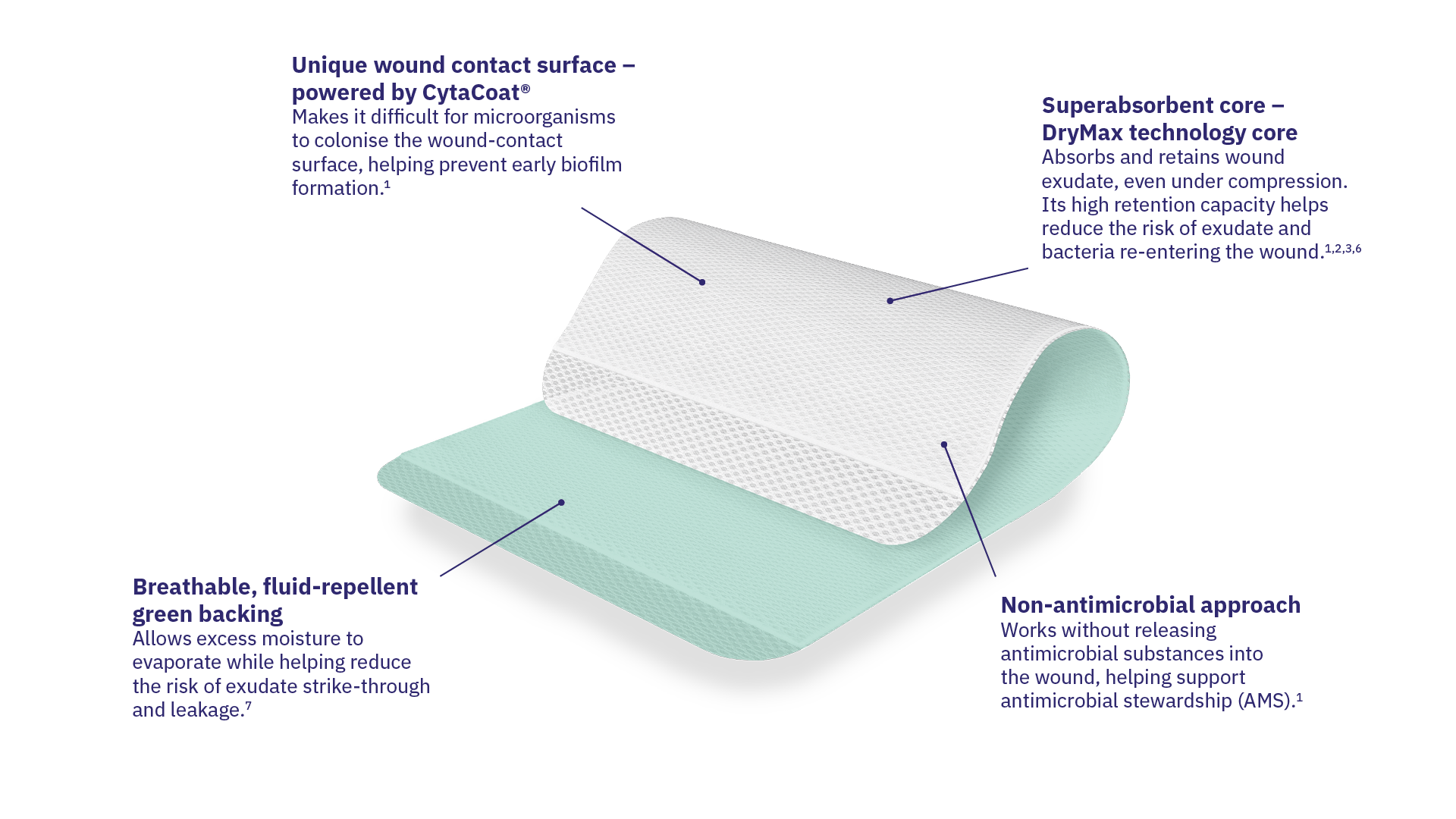
The dressing has a white wound contact layer that is placed towards the wound, helping to retain moisture and support a favourable wound-healing environment.²˒³˒⁴˒⁵
The wound contact layer can have a preventive effect on biofilm formation on the dressing surface and its immediate surroundings.¹ The biofilm-preventive function is based on a mechanism that does not release antimicrobial substances or kill the bacteria.
The dressing effectively manages wound exudate containing both bacteria and fungi.¹˒⁶ The white surface efficiently transports exudate away from the wound and distributes it evenly throughout the dressing’s DryMax Technology core.
The dressing has a green hydrophobic backing to reduce the risk of wound fluid strike-through. Its thin, soft, conformable design makes it suitable for all areas of the body. The seamless wound contact layer makes it easy to position over the wound. Absorbest BioShield is designed to work well with compression therapy.²˒³˒⁵
| Size | Item number | Qty/box | Absorption |
|---|---|---|---|
| 5x5 cm | F60910/10 | 10 | 20 ml |
| 7.5x7.5 cm | F60911/10 | 10 | 60 ml |
| 10x10 cm | F60913/10 | 10 | 125 ml |
| 10x20 cm | F60915/10 | 10 | 310 ml |
| 15x20 cm | F60914/10 | 10 | 400 ml |
| 20x20 cm | F60916/10 | 10 | 600 ml |
| 20x30 cm | F60917/10 | 10 | 910 ml |
The wound-contact layer helps prevent biofilm formation on the dressing and in its immediate surroundings.¹
The biofilm-preventive effect relies on a non-antimicrobial mode of action that does not kill bacteria. Instead, the wound-contact surface makes it difficult for microorganisms to colonise the surface.¹
Choosing non-antimicrobial dressings when antimicrobial substances aren’t required supports antimicrobial stewardship (AMS) and contributes to the responsible use of antimicrobial treatments.¹³˒¹⁴˒¹⁵
The white surface efficiently draws away wound fluid containing both bacteria and fungi¹˒⁶ and distributes it evenly throughout the DryMax-technology dressing core.
The dressing has a green, hydrophobic backing that helps reduce the risk of wound fluid strike-through. Its thin, soft, conformable design suits all body areas, while the seamless wound-contact layer makes it easy to position over the wound. Absorbest BioShield is designed for use with compression therapy.²˒³˒⁵
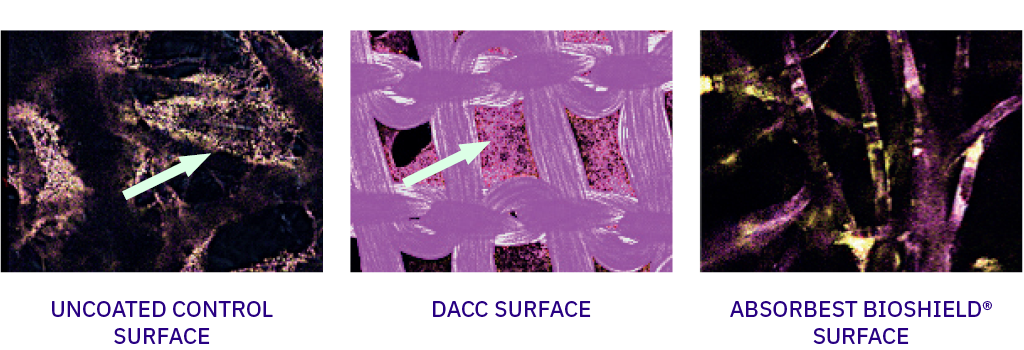
After seven days, structured biofilm is present on both the uncoated control and DACC surfaces. In contrast, the Absorbest BioShield surface shows only scattered microbial cells, with no structured biofilm. The arrows highlight the key difference in organisation: biofilm forms dense, organised clusters of microorganisms.
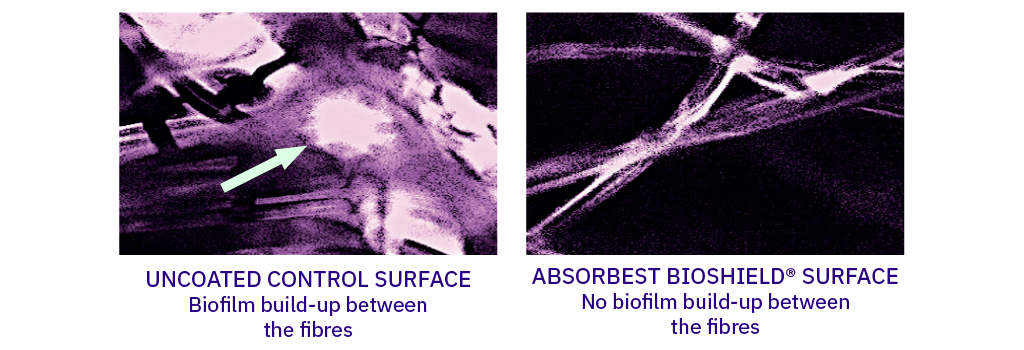
In a preclinical porcine wound model, the Absorbest BioShield dressing had less biofilm accumulation on the surface, and the bacterial burden in wound tissue decreased more rapidly than with the control dressing.

Absorbest BioShield absorbs wound fluid and captures bacteria and fungi in the dressing core. Its technology helps prevent biofilm formation without using antimicrobial substances.
No. Absorbest BioShield contains no silver or other antimicrobial substances.
Yes. Absorbest BioShield is designed for use as a primary dressing, placed directly on the wound. For its biofilm-inhibiting surface to work optimally, position the white side against the wound bed. This helps the dressing manage exudate effectively and prevent biofilm formation where it is needed most.
The white side.
The white surface helps prevent biofilm from forming, while the dressing’s absorbent core removes exudate and bacteria.
Yes. Absorbest BioShield is designed to work well with compression therapy.
Absorbest BioShield is designed for exuding wounds, especially hard-to-heal wounds at risk of biofilm formation. Apply the dressing after cleansing and debridement, once the wound bed is prepared.
Absorbest BioShield is intended for exuding wounds.²,³ It is especially suitable for exuding, hard-to-heal wounds where biofilm formation is at risk. Examples include venous leg ulcers, arterial leg ulcers, and pressure ulcers.
Note! Do not use the dressing on the eyes, mucous membranes, or tendons, or in wound cavities, as it swells when it absorbs fluid.
No, change the dressing based on the wound’s clinical condition and before it becomes saturated. Absorbest BioShield requires less frequent dressing changes than conventional dressings.⁵
For biofilm inhibition, use Absorbest BioShield as the primary dressing, though it can also be used as a secondary dressing.⁴ If used as a secondary dressing, place the white side against the primary dressing. Tailor the dressing combination to the wound’s needs and local treatment practice.
Absorbest BioShield is designed to help prevent biofilm formation from the outset. Its unique contact surface makes it harder for microorganisms to attach and take hold, helping prevent biofilm formation.¹ This differs from other non-antimicrobial dressings, which bind microorganisms only after they come into contact with the dressing.¹¹
Like other non-antimicrobial dressings, it does not contribute to the increased spread of antimicrobial resistance.¹³,¹⁴,¹⁵
The wound-contact layer creates a surface that discourages microorganisms from adhering and establishing themselves. This helps prevent early biofilm formation without using antimicrobial agents to kill them. At the same time, the superabsorbent core absorbs wound fluid and traps bacteria and other substances within the dressing.¹,⁶
1. Brookes G, Junker J, Larsson H, et al. A new non-antimicrobial dressing that prevents biofilm formation under clinically realistic wound conditions. Poster presentation EP165. European Wound Management Association (EWMA); 2026.
2. Todhunter J, Greenhow H, McSkeane A. Use of a superabsorbent dressing in wounds with moderate-to-high exudate volume. J Community Nurs. 2024/2025 Dec-Jan;38(6):38-43.
3. Collier M. A clinical observational case series evaluation of a superabsorbent dressing on exudating wounds. Br J Nurs. 2024;33(12):S29-S37. doi:10.12968/bjon.2024.0180.
4. Hindhede A, Meuleneire F. A clinical case-series evaluation of a superabsorbent dressing on exuding wounds. J Wound Care. 2012;21(11):574,576-580. doi:10.12968/jowc.2012.21.11.574.
5. Hoglin G, Freijd H. A cohort study to investigate the benefit of the use of DryMax EXTRA superabsorbent wound dressing on a population of wet wounds. In: Wounds UK Annual Conference; 2011; Harrogate, UK.
6. Larkö E, Persson A, Blom K. Effect of superabsorbent dressings in a 3D acellular tissue model of Pseudomonas aeruginosa biofilm. J Wound Care. 2015;24(5):204,206-210. doi:10.12968/jowc.2015.24.5.204.
7. Absorbest AB. Data on file.
8. Barker JC, Khansa I, Gordillo GM. A formidable foe is sabotaging your results: what you should know about biofilms and wound healing. Plast Reconstr Surg. 2017;139(5):1184e-1194e.
9. Coelho MMF, Avelino BMA, de Oliveira BA, Rios MA, do Amaral Gubert F, Martins MC, et al. Prevalence of biofilm in chronic wounds: systematic review with meta-analysis. Wounds. 2025;37(8):283-291. doi:10.25270/wnds/24124.
10. Malone M, Bjarnsholt T, McBain AJ, James GA, Stoodley P, Leaper D, et al. The prevalence of biofilms in chronic wounds: a systematic review and meta-analysis of published data. J Wound Care. 2017;26(1):20-25. doi:10.12968/jowc.2017.26.1.20.
11. Malone M, Radzieta M, Schwarzer S, Walker A, Bradley J, Jensen SO. In vivo observations of biofilm adhering to a dialkylcarbamoyl chloride-coated mesh dressing when applied to diabetes-related foot ulcers: a proof-of-concept study. Int Wound J. 2023;20(6):1943-1953. doi:10.1111/iwj.14054.
12. Brandenburg KS, Calderon DF, Kierski PR, Brown AL, Shah NM, Abbott NL, et al. Inhibition of Pseudomonas aeruginosa biofilm formation on wound dressings. Wound Repair Regen. 2015;23(6):842-854. doi:10.1111/wrr.12365.
13. World Union of Wound Healing Societies (WUWHS). The role of non-medicated dressings for the management of wound infection. London: Wounds International; 2020.
14. Blackburn J, Ousey K, Rippon M, Rogers A, Pastar I, Lev-Tov H. Applying antimicrobial strategies in wound care practice: a review of the evidence. Int Wound J. 2025;22(6):e70684. doi:10.1111/iwj.70684.
15. Maillard JY, Kampf G, Cooper R. Antimicrobial stewardship of antiseptics that are pertinent to wounds: the need for a united approach. JAC Antimicrob Resist. 2021;3(1):dlab027. doi:10.1093/jacamr/dlab027.


+46 (0)494 77 99 50
info@absorbest.se
Klintvägen 1, 590 39 Kisa

Contact us
+46 (0)494 77 99 50
info@absorbest.se
Klintvägen 1, 590 39 Kisa