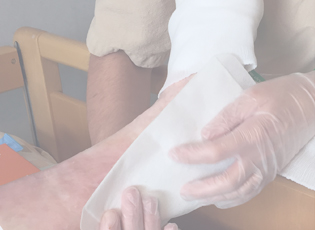
A poster presented by Absorbest at Wounds UK followed two patients with long-standing, heavily exuding leg ulcers. Their experiences highlight simple but important factors to consider when managing wound exudate and what these signs can reveal about the wound’s changing needs.
Reviewed by: Jade Roberts, Clinical Development Manager, CD Medical, Tissue Viability Nurse Specialist.

Wound exudate is a normal, essential part of healing. The goal isn’t to keep a wound dry, but to maintain the right moisture balance.
When exudate changes or exceeds the dressing’s capacity, warning signs may appear. Leakage, changes to the surrounding skin, or more frequent dressing changes can all indicate that it’s time to reassess exudate management.
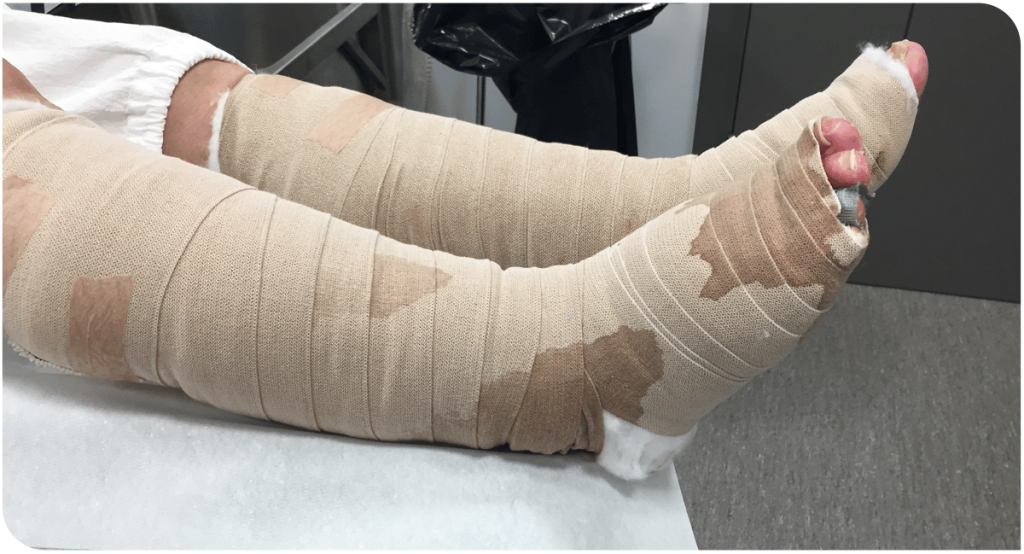
One of the two patient cases illustrates what this looks like in practice.
An 87-year-old woman with a venous leg ulcer had lived with the wound for 240 days. It produced large amounts of exudate, which leaked onto her clothes, bandages, and bedding. The wound and surrounding skin were painful, and the skin was severely macerated, softened, and damaged by prolonged exposure to moisture.
Although her case was complex, some signs that the exudate had become difficult to manage were readily recognisable.
We don’t simply want to remove exudate. It helps maintain a moist wound environment and contains substances involved in healing.
Problems can arise when exudate exceeds what you can manage effectively.
A dry wound isn’t the goal; an optimal moisture balance is.
The amount of exudate a wound produces doesn’t necessarily stay constant throughout the healing process.
In the Wounds UK case, fluid volumes were sometimes particularly high and required careful management. During these peaks, clinicians layered the superabsorbent dressing to increase its fluid-handling capacity.
So, don’t assume today’s exudate level is the same as yesterday’s. Wound changes may also mean its needs have changed.
The wound bed is only part of the picture. Excessive moisture around a wound can macerate the surrounding skin, leaving it pale or white, soft, and fragile.
In the Wounds UK case, severe maceration was one of the problems observed, along with high exudate. During the evaluation, the wound bed and surrounding skin improved.
When checking the wound, also check the surrounding skin.
A dressing can absorb fluid, but where does the fluid end up?
This is where retention matters. Simply put, retention is a dressing’s ability to hold the fluid it absorbs.
The superabsorbent dressing evaluated in the Wounds UK cases contained polymers that absorb fluid and form a gel, helping retain it within the dressing. It was also used under compression in the patient cases.
For wounds producing large amounts of exudate, it can therefore be useful to consider both how much fluid a dressing absorbs and how well it retains it.

Leakage is uncomfortable and inconvenient for the patient, but it can also provide useful information. Both cases presented at Wounds UK involved leaking wounds. In the case of the 87-year-old patient, exudate reached her clothes, bandages, and bedding, affecting her quality of life.
If leakage occurs before the planned dressing change, it may indicate that the current approach is no longer effectively managing exudate. Rather than seeing leakage only as something to clean up, see it as a prompt to reassess the wound and your exudate management.
Managing wound exudate does not always need to be complicated.
Examine the wound and surrounding skin. Note any changes in exudate levels and watch for leakage. When choosing a dressing, consider not only how much fluid it absorbs, but also what happens to the fluid afterwards.
Sometimes, simple observations can signal that the wound needs reassessment.
Experience the difference and compare the outcome with our superabsorbent primary dressing. Designed for comfort and to support a simple wound-healing process, it creates an optimal healing environment to help clinicians deliver quality care.


+46 (0)494 77 99 50
info@absorbest.se
Klintvägen 1, 590 39 Kisa

Contact us
+46 (0)494 77 99 50
info@absorbest.se
Klintvägen 1, 590 39 Kisa